Are you in crisis and need help? FIND HELP »

We Must Join Together to Address Racism and Inequality

June 3, 2020

A message from Family Services’ President and CEO about the importance of fighting social inequality in our communities.

Dear Supporters, Partners, and Friends of Family Services,

As an agency with a mission to Protect, Heal and Care for vulnerable members of our community, Family Services cannot remain silent concerning the disturbing events of this past week.

With the senseless murder of George Floyd, old and festering wounds have been exposed, not just nationally, but here in Northeast Wisconsin as well. Guilty parties must be held accountable and we must move toward helping everyone in our community to understand why people of color continue to live in fear in this country.

Our responsibility is to listen and understand the needs of others more thoroughly. As a community and as individuals, we cannot turn a blind eye to the racism and inequality that has been with us since the founding of our nation. We must understand the systemic issues which contribute to people of color being over represented in our jails and prisons. We must understand the anger and fear that resurfaces every time we see instances of brutality and excessive force by those in authority.

Racism and inequality is our collective problem and not just a problem in Minneapolis or somewhere else. Rather than placing blame on one another, we must be willing to come together as individuals and as allies to solve these problems that continue to haunt us. As we have continually said during the COVID-19 crisis, we are in this together. These words are never truer or more necessary.

Paraphrasing a common expression from the Civil Rights movement in the 1960s, we are called to action with these words – If you are not part of the solution, you are part of the problem. We must commit and we must commit now to be part of destroying racism and inequality in our communities.

Family Services continues to have a vision for our community and this vision is simple – “A community of thriving children, strong families and healthy individuals.” There is no better place to begin to realize this vision than by doing what we can to fight social inequality whenever and wherever we encounter it.

Please join us as we take on this most crucial challenge! Our actions must now speak louder than our words.  Together, we can Protect, Heal and Care.

Sincerely,

Jeff Vande Leest
Family Services’ President & CEO

Ways to Practice Mindfulness this Spring

May 12, 2020

Find out what mindfulness is and how the practice of mindfulness can help you relax and enjoy the little things.

Spring Mindfulness

Jim Dercks, MAC, LPC
Counseling Clinic Therapist
 

The smell of the flowers, the birds chirping, the warm breeze on your face, and the trees blooming.  Springtime is finally here.  The long, cold winter is over and the warmth of spring air is making its return.  Most of us miss, however, the details of spring that make it so beautiful.  Why is that?  Is it because we are too busy?  Is it because we are too focused on everything else in life?  Is it because it comes every year so it’s nothing new, been there done that?  These are just a few examples as to why we miss out on the small, detailed wonders of our world.  This is where mindfulness comes in.

Mindfulness is a mental state where you become completely aware of your surroundings and your body.  Mindfulness is living in the present, not the past or future, and being aware of where you are at in that current moment.  To achieve perfect mindfulness, a person is in touch with all five senses: taste, touch, smell, sight, and sound.  They acknowledge where they are at and they take it in – all of it.

With spring arriving, this is a great time to practice your own mindfulness.  When you hear the birds start chirping, take in the sounds.  Chances are you have not heard bird sounds in months.  Enjoy their songs and how they communicate with each other.  As it starts getting warmer out, go outside and take in the heat of the breeze and block out everything else.  Let your body enjoy that warmth as you meditate on it.  When you see some flowers that are blooming, take a moment to enjoy the coloring of the flowers after a white winter.  Go up and smell those flowers and try to capture every scent that they give off.  If you are one for dancing in the rain, spring comes with a lot of it.  Feel the rain as it comes down, listen to it splash on the ground, taste the raindrops, and enjoy the moment.  Being mindful keeps you in the present moment to take it all in.

Mindfulness brings with it a sense of peace and understanding.  If you would like to explore other helpful ways to enhance your mindfulness this spring, please follow the link https://mindfulminutes.com/springtime-mindfulness-6-ways-invigorate-practice/ to practice and learn six more ways to do so from Melissa Eisler.  Let us all be more mindful this spring and remember to enjoy the little things!

Tagged ,

Mental Wellness and Parenting in a Pandemic

May 5, 2020

Four ways to protect your and your family’s mental wellness during the global COVID-19 outbreak.

By Tammy Ullmer
Family Support Specialist
Women’s Recovery Journey
 

It’s 10 o’clock in the morning and so far I have built a perfectly symmetrical castle with blocks, baked three-dozen cookies, played two games of Trouble plus a tie-breaker game, had a lengthy discussion about sportsmanship, washed two loads of laundry, unloaded and reloaded the dishwasher and made it around the block with my 3rd grader, my preschooler, my baby in the stroller, and our dog who thinks he needs to water every single yard we pass. Sound familiar?

Parenting during a pandemic is not for the faint of heart. COVID-19 has thrown us all into a world of uncertainty. We are not only parents but also teachers, friends, entertainment, and referees to our children. In times like these, we must turn to the golden rule of air travel: Put your own oxygen mask on first, before helping those around you. Translation: We must take the time to care for ourselves (without feeling guilty) before we can effectively care for our children. Below are 4 tips to help guide your parenting to promote your own mental wellness as well as your children’s mental wellness.

You Don’t Have to Be Perfect. Without childcare or babysitters offering you a break, self-care might mean taking an extra minute for yourself hiding in the bathroom. Or, a bubble bath after the kids are in bed. It could be picking up a practice like meditation, deep breathing, a new hobby, journaling, or simply allowing yourself additional screen time. Give yourself room to not be a perfect parent, because there really is no such thing. Having 16 hours a day to fill to keep our children happy, occupied, schooled and well fed does not allow time for perfection. If you are doing your best, you are doing enough! It is more crucial to set a good example for your children by being calm, emotionally healthy, and reliable. Kids will model how their parents behave and react. If you raise your voice, appear stressed, exhibit erratic behavior or appear panicked, your children will do the same.

Let Them Be Bored. Not keeping your children busy 100% of the day will not cause them permanent harm. You are not a cruise director. You do not need to plan out every single second. Remember that quality is more important than quantity when it comes to time with your children. Scheduling every single minute of their day will just exhaust all those involved. Try to find a balance, exhibit calmness and let them know that uncertainty is a part of normal life and should be taken one moment at a time. This is how our children will learn resiliency, which is one of the most important skills they will use throughout their lives! When they look back on this time in their childhoods, they will not remember which games you played with them or how many cookies you baked. Instead, they will look back and remember whether you were present for them, whether you were calm and gentle with them, the ways you reassured them and squashed their anxieties, and all the ways you rooted them in reality and mindfulness.

Be Open About What is Happening. Please talk to your children about the virus and why all our lives are so different right now. Children know their lives are different. They have heard about the pandemic from the news, social media, and their friends or perhaps through overhearing your conversations with other adults. If the topic is not discussed with them directly, your child may begin to believe that the virus is unbelievable or scary. Without the facts their imaginations can run wild. Speaking to them about the virus will be an opportunity to dispel myths and teach them about the importance of gathering information from reputable, reliable sources. This will not be through social media outlets or other people’s personal opinions.

Accept the Lack of Control. We need to teach our children there are things in life that they (and you) cannot control. In times like these, it is important to encourage your children to focus on what they can control rather than what they can’t. In this case, they can control their home routines, schedules, and personal hygiene. This is a great opportunity to teach them to wash their hands regularly, sneeze or cough into their elbow, and to use at least 2 tissues at a time to blow or wipe their noses. Explain to them what social distancing means and how practicing it can help them stay safe. You can also help your children learn to identify their own feelings about what is happening. Play a game of “Emotions Charades” by having each player act out an emotion and guessing what that emotion is. Explain why it’s okay to feel those emotions and suggest healthy ways of dealing with them.

This should be a time of building memories…happy ones, not memories of excessive stress over how to fit 20 things into each day and which 20 different things you are going to do tomorrow. Remember to take care of yourself first and be sure to watch your children for changes in their sleep patterns, changes in appetite, mood fluctuations or expressions of self-harm. If you notice any of these changes please know that there are crisis workers, therapists and support specialists available by phone or virtual visits to help. We can’t always be everything to our children. Knowing when to ask for outside help is crucial to keeping our children happy, healthy, safe, and mentally well.

Tagged , ,

5 Things to Know if You’ve Been Sexually Assaulted

April 21, 2020

If you’ve experienced sexual assault or abuse, the following advice can help you find support and begin to heal.

Sexual Assault Awareness


By Daniela Santiago
Sexual Assault Center Advocate

The experience of a sexual assault or sexual abuse can leave you feeling all over the place. You may be unsure who to call, where to go, or what to do next. It’s normal to feel emotions like shock, disbelief, shame, guilt, fear, anxiety, and/or suicidal thoughts.

As a Sexual Assault Center Advocate, I want you to know that help and support are available – free of judgement, free of cost, and fully confidential. If you’ve been sexually assaulted, here are 5 things to know to help you decide how, when, and where to get help.

1. Are you safe? Your safety is a top priority. If you do not feel safe, reach out to someone you trust who will provide a place where you can feel safe.

2. This was not your fault. The only person to blame is the perpetrator. It does not matter what you were wearing or what you said. No one deserves to be abused or harassed.

3. Know your options. You are not required to report what happened to you. If you do feel comfortable reporting, contact law enforcement in the area where the assault happened. Whether you report the assault or not you can be connected to an advocate with the Sexual Assault Center in your area by calling (920) 436-8899. Our advocates will offer you support and can connect you with local resources. Remember that advocates are specially trained staff who will be non-judgmental and believe you! You can also seek medical care. Doctors and nurses will not force you to report the assault. Depending on when the assault occurred, a Sexual Assault Nurse Exam (SANE) could result in valuable evidence – evidence that can be submitted whether you choose to report now or later.

4. Healing is not immediate. It may take months to years to heal from a sexual assault due to its traumatic effect on an individual. It is important that you listen to your emotions, your body, and your mind. You may wish to speak with a professional counselor who will listen to you and teach you tools to use as you become a survivor of sexual assault.

5. You are not alone. There are support groups available where you can meet with others who have survived sexual assault in a relaxed and safe environment, all while learning ways to cope. There are many community resources staffed with people who want to help you, support you, and see you succeed. It’s never too late to speak up!

Sexual assault, abuse and harassment touches many lives. We know that it happens to children, adolescents and adults. No matter what your situation is, the Sexual Assault Center is here to help you find a way forward. For more information about our services, please visit our web page or call us at one of the 24/7 hotline numbers listed below.

Brown County: (920) 436-8899
Door County: (920) 746-8996
Marinette County: (715) 732-7300
Oconto County: (920) 846-2111

All Sexual Assault Center Services and free and confidential.

Tagged

Message from the President: COVID-19 and Mental Health

April 20, 2020

A video message from our President and CEO about COVID-19 and its impact on mental health.

The impact of the COVID-19 Pandemic on people’s mental health will be felt long after our lives return to some kind of normalcy.

Today, I wanted to share a brief message with you about this challenge, how Family Services is responding, and how we are preparing for the immense needs to come.

Thank you and stay safe,

Jeff Vande Leest
President & CEO
Family Services of Northeast Wisconsin

Tagged ,

Toddler Tantrums: Inside the Mind of a Child

April 14, 2020

What parents are thinking vs. what toddlers are thinking during a tantrum. Plus, tips to help you keep your cool while helping your child calm down!

Toddler tantrum

By Elissa Kraynik
Supervisor/Family Support Specialist
Parent Connection

If you have a toddler in your household, you know how important routine can be. But right now, try as you may, your usual routine might not be happening. Sleep schedules, daycare, play dates, and trips to the playground are all things that helped you and your child stay on a familiar and comforting rhythm. Without them, you may be feeling stressed and your toddler might be, too.

How does a toddler show their frustration or confusion? Tantrums. And a tantrum is almost guaranteed to make an already stressful parenting situation even more stressful. Before you react, it’s important to take a step back and think through what is REALLY going on. Both in your mind, and in your child’s mind.

Say you’ve just told your toddler that they can’t do or have something that they want. After some back-and-forth, your toddler hits the ground crying and screaming. They may even yell, “I hate you!” In YOUR mind, you are likely thinking or feeling the following:


Parent/Caregiver Brain:

“My kid hates me”

“I am a horrible parent”

“I just need five minutes of quiet to myself!”

“I can’t wait until they go to bed!”

“I am going to LOSE it!”

“I just want to scream!”


Your feelings in these moments are extremely valid. Remember, your toddler does not hate you. In fact, they are acting this way because they feel safest and most secure with you.  Way to go! So, what exactly is going through your child’s mind during this tantrum? If they could explain it to you, this is probably what they would say.


Toddler Brain:

“That cookie is RIGHT in front of me and I’m hungry NOW! You are telling me that dinner is in my future.”

“I’m trying to find the words, but I don’t know enough words to get my emotions out.”

“I missed my nap or went to bed late last night. I am overtired physically and lack the emotional control to handle this.”

“I need Mommy or Daddy to make me feel better, because I am still learning ways to make MYSELF feel better.”

“I can’t even remember why I am crying, because this is taking a lot of energy out of me. This lack of control makes me even MORE upset!”

“I need help!”


Your toddler’s emotions have gotten in the way of their brain understanding what you are saying. They haven’t learned yet how to handle big feelings. A lot of this has to do with knowing how they feel, but not knowing enough words to get those feelings out.

Remind yourself of this: the way YOU handle this situation is modeling how your toddler should respond to THEIR big feelings. They are learning from you. Take a deep breath and count to ten. Get down at your child’s level so you are eye to eye. Validate your child’s feelings before explaining why they can’t have their way. For example, you could say to your child, “I bet you are really hungry. I’m so sorry. I bet that is upsetting. I get upset when I’m hungry, too.”

After validating your toddler’s feelings, try distracting them with new tasks. For example, you could tell your toddler, “I could REALLY use a special helper! I bet we can have dinner ready faster if you are able to be my special helper. Thank you SO much! Can I please have a hug?” After the new task is done, be sure to praise your child for what they accomplished. “I had a great time cooking with you! I’m so glad you are feeling better! I am, too!”

Remember, if you ever feel yourself getting too overwhelmed, it’s okay to take a “Mommy Time Out” or “Daddy Time Out.” Even 5 minutes of self-care can help you calm down and release some of the stress you are feeling. Take a warm bath, read that magazine article, take a walk, or call a friend. Keep in mind that it’s okay to ask for help. Reach out. There are resources and support available to you, and Family Services is here to help!

Tagged ,

Talking to kids about COVID-19

April 10, 2020

How to start a conversation with the children in your life about the pandemic and how it’s affecting them.

Talking to Kids


By Chelsea McGuire, MAC, LPC
Counseling Clinic Therapist

We are living in an uncertain time. All of us have been affected by significant stress and change. This especially applies to children who do not necessarily have the language or tools to describe how they are feeling.

If you’re a parent – caregiver – or teacher, you might be wondering how best to help children cope during the COVID-19 pandemic. We’ve put together four tips to help you put their minds at ease:

Be honest. Share age-appropriate facts about what is going on. Children tend to worry more when they don’t understand something. They will often fill in the blanks with false information to try and make sense of what is happening. Start a conversation with your child by asking how they feel about the changes to their normal routine. Invite them to ask you any questions that they might have. Let your child know that it’s okay to feel what they are feeling and help them figure out ways to handle these emotions in a healthy way.

Set the emotional tone for your child. While adults are certainly dealing with their own stressors and challenges right now, it’s important to be calm and reassuring when interacting with children. They will be observing your behavior and it is up to parents and caregivers to provide as much stability as possible. Make sure that you are taking care of your own emotions, and don’t hesitate to reach out to a mental health provider if needed.

Focus on what your family is doing to stay safe. Teach and model appropriate hand washing procedures and practice social distancing. Engage in virtual visits with family and friends to provide your child with the connections that they are missing. Challenge them to spread positivity by making cards for healthcare workers or nursing homes residents.

Lastly, work to maintain a sense of normalcy. While your children may not be going to school or able to see their friends, they are still able to learn, be active, use their imagination, and help out around the house. Stick to their regular routine as much as possible.

All of us are figuring out how to navigate this new way of life. The same goes for our children. If you find that your child is struggling with anxiety, depression, or behavioral concerns during this time, please don’t hesitate to reach out to a professional therapist for help.

Tagged ,

How to Turn Parenting Stress into Success

April 7, 2020

Tips to help you keep your cool and respond, rather than react, when your child’s behavior pushes you to the edge.

Parenting Stress

By Heather Goetsch
Family Support Specialist
Early Head Start

Take a moment to think about how you manage stress and conflict with your children. Do you yell? Do you behave in ways you later regret? Rather than yelling or shouting when a child isn’t listening, you can make a commitment to using a new skill – one that is proven to benefit your child as well.

Picture this: Your child has not been listening to your requests throughout the day. This has led you to raise your voice. You may even punish your child by sending them to their room. In turn, your child is now responding with a full-blown, tear-filled tantrum. Nobody is feeling good about this situation. You’re upset and your child is upset.

Now imagine trying this: After a full day of struggling with your child’s behavior, you feel your fuse shortening. Instead of losing your cool, you choose to follow the strategies of what is known as Conscious Discipline:

Control Yourself First

Remind yourself that the only person you can change is yourself. This is a powerful way of thinking. You cannot control how others around you may respond, but you can choose to control yourself. This is self-control.


Just Breathe

Breathing is something we all know how to do, but are we choosing to do it? That is what Conscious Discipline is all about, about committing to the skill. In moments when you feel overwhelmed by your children, try practicing this breathing technique from Conscious Discipline, called STAR.

S– Stop. Commit to pausing here. Pause your response. This pause gives you the chance to think about how to respond rather than react.

T- Take a deep breath. Your inhale should push your stomach out and last about four seconds. Your exhale should bring your stomach in and last about eight seconds.

A – And…

R– Relax. Allow your deep breaths to calm you. Remind yourself, “I am safe,” “I can handle this,” and “keep breathing.”

When you actively choose to use Conscious Discipline, you are not only choosing to regain your composure and self-control, but you are also downloading calm onto your child. You are giving them the skills that they will one day need to self-regulate themselves.

Remember, chaos invites chaos. But calmness, love and composure are also contagious. By choosing self-control and by choosing to breathe, to actively and consciously breathe, you are allowing yourself to find your calm and to share it with your family. Life isn’t always easy, and parenting is challenging. Remember to be kind to yourself and just breathe. For more information about Conscious Discipline and the skills it offers for parents and children, check out the Conscious Discipline website at www.ConsciousDiscipline.com.

Tagged

Child Abuse Prevention and Sexual Assault Awareness Month

April 1, 2020

How you can help Family Services raise awareness of child abuse and sexual assault throughout the month of April.

Pinwheels for Prevention
The pinwheel is the national symbol of Child Abuse Prevention.

By Erika Ritchie
Staff Writer

April is Child Abuse Prevention and Sexual Assault Awareness Month. This year, our efforts to raise awareness and create positive change are as critical as ever.

The COVID-19 Pandemic has changed day-to-day life dramatically. Although the risk to children’s physical health from the outbreak itself appears to be lower…the risk to children for experiencing sexual or physical abuse or neglect is actually quite high. During this time of social distancing, children who are being abused have fewer safe places to go and fewer trusted adults to protect them.

One of the key ways we can prevent abuse from happening now – and all year round – is by ensuring that parents have proper support and guidance. Now is an especially stressful time for families as parents may be working from home or laid off and children are at home with them 24/7. For some parents, stress and frustration may begin to build up and, in extreme cases, it is children who may suffer.

Family Services continues to support hundreds of families during these difficult times. Thanks to our generous supporters, our staff have been busy reducing the stress on parents by delivering critical supplies to help meet their children’s basic needs. Home visitors are also providing much-needed support and encouragement to parents through virtual visits.

The COVID-19 Pandemic is also impacting the lives of survivors of child abuse and sexual assault. Their court cases seeking justice may be delayed. Anxiety around the outbreak may also be taking a negative toll on their healing process. Our Sexual Assault Center and Willow Tree Cornerstone Child Advocacy Center advocates are giving survivors all the support they can right now. Therapy sessions are being conducted via Telehealth, and our Sexual Assault Center hotlines remain open for those who need us.

Throughout the month of April, we’ll be sharing a series of blog posts in honor of Child Abuse Prevention and Sexual Assault Awareness. These articles will offer parenting advice, tips on how to support survivors, and developmentally appropriate ways to talk to children about abuse.

You can also join advocates from our Sexual Assault Center by participating in the #30DaysofSAAM challenge in honor of Sexual Assault Awareness Month. To join, please follow @sacfsnew on Facebook and Instagram.

And if you’d like to help us continue delivering critical supplies and support to ensure that children are properly cared for, you are welcome to donate to our emergency COVID-19 fund.

Thank you for helping us raise awareness of these critical issues and for allowing us to protect, heal, and care for the children, families, and individuals who need it most during this unprecedented health emergency. And remember – now, more than ever, it is important to check in on your friends, family and neighbors in whatever way you safely can.

StayIN’ Purposed and Helping Families

March 27, 2020

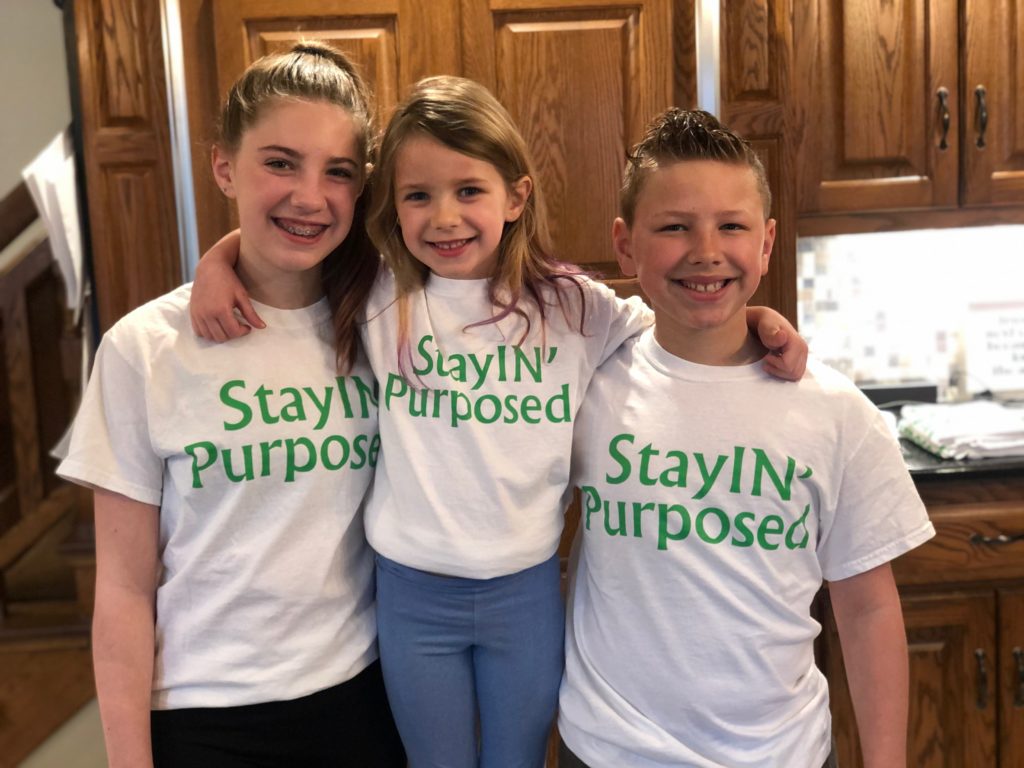
T-shirt campaign aims to help you share the importance of StayIN’ Purposed during the COVID-19 Pandemic while helping others.

StayIN Purposed

By Erika Ritchie
Staff Writer

Now more than ever, it is important that every one of our actions be done with purpose. Some of you are still going to work to provide critical needs for the community. Many more of you are doing your part by staying home to work, cook, learn, educate, exercise and more. All of us are being asked to take extra precautions for our health and the safety of others. By StayIN’ Purposed in our actions we are all supporting the Safer at Home directive.

Lyssa King and Heather Voss are friends of Family Services who want to help YOU show your pride for StayIN’ Purposed during the COVID-19 Pandemic. They developed this concept and t-shirt design and now want to offer it to YOU!

When you purchase a StayIN’ Purposed T-shirt, $7 from each shirt will go directly to Family Services to help purchase and deliver critical supplies to families in need. Supplies like formula, diapers, wipes, and food. You’ll be showing your community the importance of StayIN’ Purposed while making an immediate difference in the lives of parents and children!

To purchase your StayIN’ Purposed shirt(s), please click the button below:

If you want to purchase t-shirts in bulk for your workplace, please contact Lyssa directly at [email protected]. Companies that order 25 or more can have their company logo added at no additional cost!

We look forward to StayIN’ Purposed with you. We’d love to see you post pictures of yourself, your family and your co-workers on social media using the hashtag #stayinpurposed to help spread the word and inspire your circles to Stay Purposed, Stay Strong and Stay Healthy!